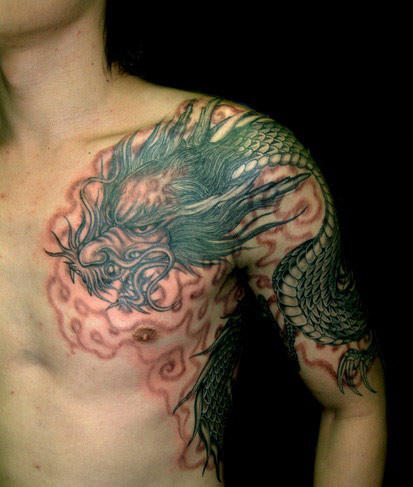
The most well known and most popular mythical creature depicted in tattoos is the Japanese dragon. It is more popular than any of the other mythical creatures, such as the phoenix, mermaid or gryphon. This may be due to its shape because the long and flexible dragon that descends from Japanese tattoo traditions practically fits on every part of the body - covering full backs, winding himself around arms or coiling up on the chest of the carrier.
 Dragon Tattoo
The Japanese dragon is usually depicted as a wingless, heavily scaled snake-like creature with small, clawed legs and a camel shaped head with horns. It is associated with sea, clouds or the heavens. It has whiskers and a beard, and it is deaf. In the West we think of dragons as terrifying beasts, but in Japan the dragon symbolises wealth, good fortune, good luck, kindness, power and freedom.
The good luck stems from the fact that the Japanese dragon is a "water symbol", living either in the clouds, climbing down during thunderstorms, or in rivers and lakes. Water is an element of enormous importance for the cultivation of rice in both China and Japan so, because of its ability to bring down the rain, it was revered. Thus dragons are highly respected and admired in both China and Japan. In the Western Culture however, because of the association with the snake, the dragon symbolises evil and they were routinely hunted down, fought and killed.
 Dragon Tattoo
It is important to keep the dragon happy because, after all, it could easily cause a seaquake or thunderstorm if annoyed. One of the most famous and most tattooed dragon legends, apart from the display of the Buddhist gods of wind and thunder (Fu-jin and Rai-jin) who are riding the dragons, is the Tamatori Hime. According to legend, Japanese dragons are believed to take up the shape of humans and are even considered capable of mating with humans. The age-old enemy of the dragon is the phoenix and sometimes a bird-man creature called Karura.
 Dragon Tattoo
At birth to around five hundred years (or so) of the dragon's life, they are a "water snake". They are not dragons in the sense that we think them to be. From five hundred (or so) to around one thousand (or so) they become Chiao, or scaled creatures. They are said to begin as a fish, and, at a considerably old age, turn into a scaled dragon.
 Dragon Tattoo
After the Chiao stage, from about one thousand years to one thousand five hundred years old, the dragon grows rapidly. This is when the dragon becomes a Lung dragon. This takes place over the five hundred year period. Unlike some dragons, they are hornless and symbolize the scholar. These dragons can gain horns, but only after about five hundred years.
When the dragon is between the ages of one thousand five hundred and two thousand, he or she will become a Horned Dragon. They will gain horns and thus look much wiser in the process. After the dragon is two thousand years old, they become a Ying-Lung. They are winged dragons that are also scale-less. They gain wings only after they have been around for about one thousand years, and they never have scales.
 Dragon Tattoo
The Japanese dragon (referred to as Ryugu in Japanese mythology) has three toes whereas the Korean has four and the Chinese five. It is said in Chinese Mythology that all dragons originated from China and the ones that left lost their toes, but the Japanese Culture believes that all dragons came from Japan and when they left Japan they gained toes. The farther the dragons went, the more toes they gained (or lost). The Koreans believe that all eastern dragons originated from Korea so that when the dragons leave Korea and go towards China they gain toes and when they go towards Japan they lose toes.
 Dragon Tattoo
Another difference is that Japanese dragons tend to be much more slender and fly less frequently than their Chinese counterparts which suggests they either lose or gain weight depending on where they originate from. In Japanese society (as in Chinese society) dragons are depicted in paintings on temple walls and carvings. Most of the temples with dragon carvings usually belong to the Zen Buddhism religion. The Japanese dragon had originally come into existence as a guardian creature that was in charge of guarding all the four cosmic regions. Traditionally the dragon is identified with the season of spring throughout Asia.
 Dragon Tattoo
The Dragon King is really four dragons, and these dragons keep watch over the four main seas. They are believed to live underwater in the Ryuku islands area in Okinawa. Japanese dragons are of various types: there are the Tatsu dragons that are a representation of spirituality and imperial power and tend to live in lakes or springs. The Sui-Riu dragons are held responsible for bringing rains into the islands of Japan. The Han-Riu dragon is the tallest of the dragons measuring up to almost 40 feet in length and can reach the heavens. The Ri-Riu dragon is most popular for its unusual eye-sight which is believed to be the best. The Ka-Riu dragon which is the smallest possesses a frightening red color. The Fuku Riu is the dragon which brings luck to people. The Hai-riyo dragon is actually a dragon which possesses a bird-like shape and is the most evolved of all the dragons.
 Dragon Tattoo
Other interesting things to note are the differences between the dragons in pictures. For example, males usually have clubs in their tails while females hold fans. These dragons can also be depicted as descending from the sky or inside clouds. Male horns are thinner near the base of the head and thicker and stronger towards the outside. Females have "nicer" manes, they are rounder, and thus are seen as more balanced than the rigid mane of the males. The females' noses are usually straighter, their scales thinner, and have a thicker tail.
 Dragon Tattoo
Modern Japanese tattoo artists have taken the art of the Japanese dragon to amazing new levels. Whether you want a full back or a half sleeve design, you will find an incredible gallery of amazing tattoo designs to choose from. They can be in colour, or black and white. The Japanese dragon tattoo may appear with sea waves, clouds or pearls. Sometimes the dragon holds an enormous magical pearl in its claw, which has the power to multiply whatever it touches, the "pearl" symbolized the most precious treasure: Wisdom (hence "pearls of wisdom"). Ancient Dragon lore and illustrations have inspired many of us to select a Japanese dragon tattoo because that design represents how we feel about ourselves -- strength, wisdom and freedom...
 Dragon Tattoo
Japanese dragon tattoos can wrap around the body and flatter the contours of the body. Full body and full back dragon tattoos are very common in Japan, but the most popular location is half sleeve, the body of the dragon wraps around the upper arm and the dragon's head extends across the chest just above the heart. Because of the long shape of the dragon, it is also well suited for inking on arms and legs.
Article By: Alan Watt